If you have been watching Redwood City housing, you have probably noticed a pattern: most of the “new” homes are not appearing on empty land. They are showing up on existing lots, along key corridors, and in small redevelopment projects across an already built-out city. That can make the market feel harder to read, especially if you are weighing a new-construction purchase, tracking neighborhood change, or planning your next move. In this guide, you will learn how infill and new construction are reshaping Redwood City housing, where growth is showing up, and what it means for buyers and sellers. Let’s dive in.
Why infill matters in Redwood City
Redwood City is a highly urbanized Peninsula city with very little vacant land left for large-scale development. According to the city’s 2023 to 2031 Housing Element, future residential growth is expected to happen mainly in low-, medium-, and moderate-density residential zones, along major corridors, and downtown.
That makes infill the main path for adding homes. Instead of building new subdivisions on open land, housing growth is more often tied to redeveloping existing parcels, replacing older structures, and finding ways to add units within the city’s current footprint.
The scale of that effort is significant. Redwood City’s Regional Housing Needs Allocation target is 4,588 units, and the city’s annual housing reports show an active pipeline that includes entitlements, permits, certificates of occupancy, and a steady number of ADU permits.
Where new housing is concentrating
Downtown and El Camino Real
City planning documents point to downtown and El Camino Real as key growth areas. These locations are better positioned for mixed-use and higher-intensity housing, which helps explain why larger infill projects tend to cluster there rather than deep inside detached-home neighborhoods.
One reason is zoning. The city’s housing analysis notes that mixed-use zones do not have minimum lot-area requirements, which can make redevelopment more feasible in those areas.
Established residential neighborhoods
In lower-density neighborhoods, change usually looks smaller and more incremental. You are more likely to see replacement homes, duplexes, ADUs, JADUs, townhomes, or carefully planned lot-by-lot redevelopment than a large master-planned community.
This is a practical result of Redwood City’s built-out layout and zoning rules. In many cases, adding housing means making better use of an existing lot rather than finding a brand-new one.
What infill looks like on the ground
Smaller-scale product types
In Redwood City, infill housing often takes forms such as:
- Replacement single-family homes
- Duplexes and triplexes
- Townhomes
- Small multifamily buildings
- Mixed-use residential projects
- ADUs and JADUs
- SB9 projects on qualifying lots
This mix reflects the city’s zoning structure and the limited supply of vacant land. It also means buyers need to think beyond the idea of a traditional new-home subdivision when they search for newer housing in Redwood City.
Lot constraints shape what gets built
Lot size and lot width matter more here than many buyers expect. In lower-density zones, RH lots require 10,000 square feet and 60 feet of average width, while R-1 lots require 6,000 square feet and 50 feet of average width.
In multifamily areas, the city’s housing analysis says lot-area and lot-width minimums can be a major barrier. It notes that only 4 percent of R-2 lots are wide enough for a triplex, and only 6 percent of R-4 or R-5 lots have the width needed.
That often pushes redevelopment toward lot consolidation. In plain terms, builders may need to combine parcels or intensify use on an existing lot to make a project work.
How newer homes are changing neighborhood character
More compact and more vertical
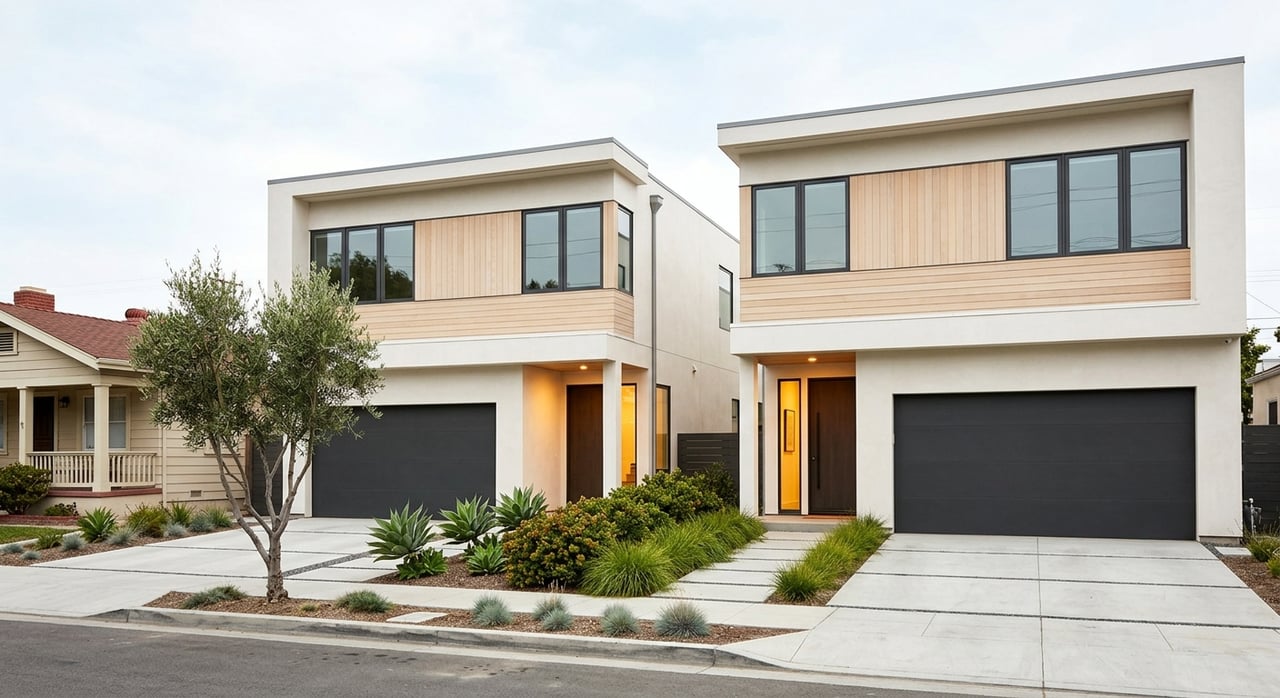
Compared with older housing stock, newer infill homes in Redwood City often look more compact and more vertical. That is partly driven by lot constraints and partly by the city’s design standards, which focus on massing, setbacks, and garage placement.
The result is a newer housing product that often uses space more efficiently. For buyers, that can mean modern layouts, cleaner lines, and better indoor-outdoor planning, but it can also mean a different relationship to privacy, yard space, and parking than in older homes.
Design review plays a real role
Redwood City’s floor area ratio policy affects many single-family infill projects and major remodels. The city says projects over 3,000 square feet or 45 percent of the lot, whichever is greater, require Planning Commission review, although new homes or additions on lots under 5,000 square feet are exempt from that rule.
That matters because new construction is not only about what fits physically on a lot. It is also about how the project is reviewed for compatibility with its surroundings.
Why ADUs are such a big part of the story
ADUs are one of the clearest examples of Redwood City infill in action. The city allows detached ADUs with 4-foot side and rear setbacks, exempts ADUs from lot-coverage calculations, and states that ADUs under 750 square feet are not charged impact fees.
That makes ADUs one of the most practical ways to add housing in established neighborhoods. Redwood City’s 2024 annual housing data also showed 49 ADU permits, which highlights how meaningful this category has become.
The city is also launching pre-reviewed ADU plans that can shorten permit review to 30 days. Even so, site-specific planning still matters because each property may require its own foundation design, utility coordination, wildfire-interface review, and fire-flow testing.
SB9 adds another path for change
SB9 creates another small-scale redevelopment option in single-family areas. Redwood City’s zoning code says the city implements Government Code 65852.21 for SB9 projects, which city materials describe as one or two new units on an existing lot or on a lot created through an urban lot split.
For homeowners and buyers, this is important because it expands the range of what a property might support over time. It does not mean every lot is a straightforward development opportunity, but it does add flexibility to some single-family parcels.
What the pipeline says about market direction
Redwood City’s recent housing reports show that the city is not just planning for infill. It is actively processing and delivering it.
The 2025 annual report lists 352 entitlements, 489 building permits, and 72 certificates of occupancy. The 2024 report counted 176 permitted infill units across 52 projects. Those numbers support the idea that a meaningful share of new housing is coming from infill and small-scale redevelopment rather than large vacant-lot construction.
For buyers, that means new supply is arriving in stages. Much of it is still moving through the entitlement and permitting pipeline, which can limit how much finished inventory hits the market all at once.
What buyers should look at in a new home
Beyond finishes and floor plans
In Redwood City, evaluating a new or recently built home takes more than admiring the kitchen and the fixtures. You also want to understand how the home fits the lot, how it handles privacy, and how the garage and outdoor space affect day-to-day living.
Parking, massing, and neighborhood compatibility can influence both livability and long-term appeal. Two homes with similar square footage can feel very different depending on how they sit on the site.
Site conditions can change the equation
Lot-specific conditions are especially important in Redwood City. Foundation type, utility placement, flood zone conditions, wildfire-interface exposure, and permitting complexity can all affect the value and functionality of a property.
This is one reason local guidance matters in new construction. A polished final product may look simple from the outside, but a lot of the true value is tied to how well the lot and the project were handled behind the scenes.
What this means for sellers
If you own a home in Redwood City, infill can shape your market position in several ways. In some cases, nearby redevelopment can introduce newer competing inventory. In others, it can increase interest in your location by bringing more housing options and investment into the area.
It also means buyers are getting more selective. They compare older homes against newer, more turnkey options, which raises the importance of pricing, presentation, and a clear understanding of where your home fits in the local housing mix.
Redwood City remains a fast-moving market
Even with more housing in the pipeline, Redwood City remains active. Recent market data from Redfin indicates that homes receive about five offers on average, sell in around 11 days, and posted a median sale price near $1.98 million over the last three months.
That pace helps explain why well-positioned new construction can still move quickly. Buyers continue to respond to turnkey homes, especially when the product is priced in line with neighborhood demand and presented clearly.
Why local insight matters more now
Infill housing can make a market more dynamic, but it can also make it more complex. Each block may have a different mix of older homes, replacement homes, ADUs, townhomes, and small redevelopment projects, all shaped by lot size, zoning, and approval rules.
That is why Redwood City is increasingly a parcel-by-parcel market. If you are buying or selling here, the best decisions usually come from understanding not just the home itself, but also the development pattern around it and the pipeline ahead.
Whether you are comparing a new-construction opportunity, preparing a resale home for market, or trying to access early inventory, working with a team that understands both neighborhood dynamics and builder process can give you a real edge. If you want expert guidance on Redwood City housing, connect with Real Smart Group.
FAQs
How is infill development changing Redwood City housing?
- Infill is becoming the main way Redwood City adds homes because the city has very little vacant land left, so growth is happening through redevelopment, ADUs, corridor projects, and small-scale new construction.
Where is new construction most common in Redwood City?
- Larger infill and mixed-use housing tends to concentrate downtown and along El Camino Real, while established neighborhoods more often see replacement homes, ADUs, duplexes, and other smaller projects.
What types of new housing are common in Redwood City neighborhoods?
- Common product types include replacement single-family homes, townhomes, duplexes, triplexes, small multifamily buildings, mixed-use projects, ADUs, JADUs, and SB9-related development.
Why are ADUs so important in Redwood City?
- ADUs are one of the most practical ways to add housing in established neighborhoods because the city allows flexible setbacks, exempts them from lot-coverage calculations, and supports pre-reviewed plan options.
What should buyers evaluate in Redwood City new construction?
- Buyers should look at lot fit, privacy, parking, garage placement, massing, utility layout, foundation conditions, and any site-specific factors that may affect livability or long-term value.
Is Redwood City still a competitive market for new homes?
- Yes. Recent market data shows Redwood City remains active, with homes selling quickly on average, which suggests well-priced and well-positioned new construction can still attract strong demand.
How can sellers respond to more new construction in Redwood City?
- Sellers can benefit by pricing carefully, presenting the home well, and understanding how their property compares to newer turnkey options and changing neighborhood inventory.